Archive

Posts Tagged ‘Microsoft Windows’

They’re Mini-Notebooks, not Netbooks

April 29th, 2009

IDC's O'Donnell: Mini-notebooks, not netbooks

IDC's O'Donnell: Mini-notebooks, not netbooks

I just got off the horn (real reporters never call it the phone) Bob O’Donnell who tracks netbooks, er, ahem, “mini-notebooks” for IDC, one the two pre-eminent research firms that track personal computer sales and trends (Gartner is the other). Bob likes the term mini-notebook because he see them as companions to other larger and more powerful PC notebooks and desktops.
“People view them as notebooks instead of its being a web only device. We see it as a companion device,” says O’Donnell, vice president of clients and displays. “They originally had tiny screens, tiny keyboards and ran Linux and quite honestly did not do that well. Now almost 100% Windows.”

IDC conducted a spot check of users in January andy found consumers use mini-notebook the same way they use notebooks – email, browsing and word-processing.A larger study is underway to confirm the earlier finding, O’Donnell says. The idea with netbooks is that all a user needs is access to web to get and his or her data and applications. The term “netbook,” says O’Donnell. was coined by Intel to signify that they were different from notebooks, but anyone using now clearly knows that are simply the smaller sibling to Windows-based notebooks.

“We actually call mini-notebooks/netbooks because you can’t ignore the term everyone uses,” he says. Actually, the term netbook is at the center of a lawsuit where Psion is suing Intel for infringing on its trademarks so you can see why everyone may be calling them mini-notebooks, now.

And speaking of Windows, O’Donnell thinks Android-based netbooks that have grabbed the spotlight for the past couple of weeks “don’t stand a chance” competing against mini-notebooks. Android is a Linux-based operating system originally developed by Google and since taken over by the Open Handset Alliance.

“The fact is people did not want Linux or just a web-only device. Didn’t they learn the first time? Android doesn’t have device drivers and is for smart phones. Sure, everyone wants an alternative, but those are the folks who want anything but Windows or  people in Silicon Valley who want to say they have an Android netbook.”

O’Donnell isn’t buying that ARM-based netbooks will be that much cheaper than Wintel mini-notebooks, either.

“They’re not going to sell for $50. The bill of materials for an ARM-based device and Atom-based is not that different. It’s maybe $20 and all the other stuff such as memory, the display and keyboard are not going away. There’s no secret sauce here. To me, this smacks of people who want to say there’s an alternative and who hate Microsoft.”

Android Netbook Appears: Lookout Wintel

April 27th, 2009

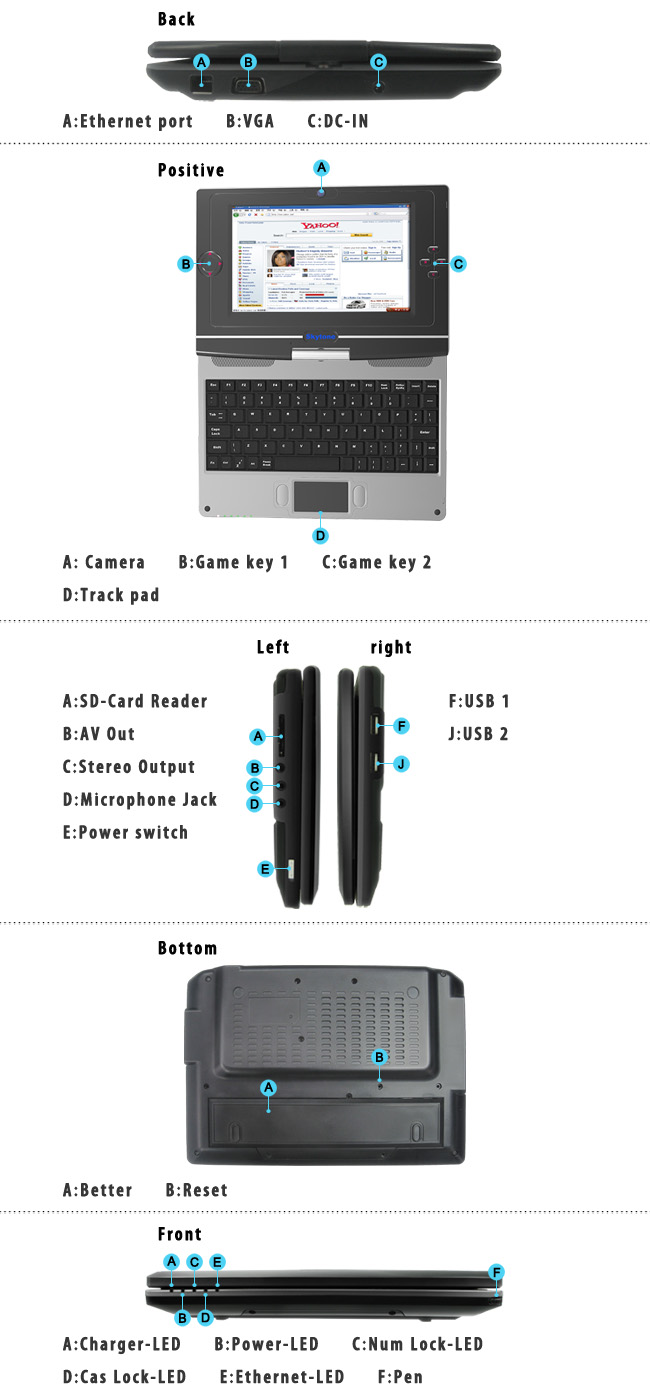
One of the first Android netbooks is being billed as an “easy to use full functioning PC” and presents tangible evidence  of a  shift away from the Wintel architecture that has dominated PC computing for decades. It certainly looks like a netbook and boasts standard apps such as email, word processor and others which can be found on the Internet.

The Alpha 680 appeared on Guangzhou Skytone Transmission Technologies Co. Ltd’s web site last week with full laundry list of specs. At the heart of the Alpha 680 is the ARM11 CPU used in a wide variety of applications ranging from automotive to PDAs. Android, the open source OS backed by Google, has generated considerable excitement in the netbook community as a serious threat to Windows in the netbook arena initially.

Last week, Computerworld blogger Seth Weintraub spotted the Alpha 680 on Ghanzhou’s web site and labeled it “a glorifed cell phone without the glory.” By that, he meant its weak specifications – a 7-inch display while most netbooks now have 10 inch or better, 128 MB of memory while most now have 1 GB, and only 1 GB of storage upgradable to 4 GB when most netbooks now have hard disk up to 250 GB.

Guangzhou Skytone has six other netbooks in the Alpha product line, several of which run Linux. The company’s  mission, according to its about page is “to provide a series of more affordable Internet access terminals…” And indeed that may be all the Alpha 680 or a netbook needs to be given standard apps such as full email, social networking and word processing apps can be used free in the Internet cloud.

Microsoft Windows relies on apps that based on each computer. What’s more, Android is free to hardware makers, giving them an immediate cost advantage. Windows XP Home Edition typically adds $15 to the cost of netbooks.

A long follow-up story in Computerworld this morning included an interview with Gangzhou co-founder Nixon Wu who said the Alpha 680 will cost about $250 which may not be enough of price differential to lure buyers away from traditional Windows-based netbooks, but it is clearly a sign of things to come. Indeed, ARM told Computerworld that as many as ten ARM-based netbooks could be on the market by the third quarter.

Prototypes of the Alpha 680 will be out in June with market ready units to follow a month or two later units , according to the Computerworld story.

Photos source: Gangzhou Skytonegangzhou1

Author: John Categories: Netbooks Tags: , , ,

Bloggers Square off on Windows 7 Starter for Netbooks

April 20th, 2009

PCmag.com editor-in-chief Lance Ulanoff takes issue with a post by Computerworld blogger Seth Weintraub and anyone else who are arguing Window 7 Starter could be a netbook non-starter for Microsoft. A Wall Street Journal story last night about Windows 7  Starter prompted several posts concluding Microsoft may have opened the door to a  Linux client on netbooks. Starter promises to be a smaller and more limited version of full Windows 7.

He  scores some good points about Linux’ complexity being aimed at the wrong end of the market — low end netbooks which are typically purchased by the least technical users. At he claims netbook makers begged Microsoft to come in and rescue the market with XP because Linux was so inept. That may be true but sounds like something like something  Microsoft whispered into the ears of journalists.

If a Linux client couldn’t gain traction through three years of Windows Vista, how could do better against against a stronger rival in Windows 7, he argues. Finally, Windows 7 will not establish Linux as a client. Linux will have to do that itself. Good points all.

But he overlooks a few things and, frankly, it’s easy to to predict same old, same old. Nothing is forever. Here are my points:

1) Windows is a monopoly which means an inefficient market in terms of cost. Something like Android were it robust (granted, a big if) could succeed in the highly cost sensitive netbook market. As netbooks become giveaways subsidized by customer committing to two years of wireless broadband, hardware and software costs will be measured in tenths of the cent as they are today with cell phones. That’s the market Android and ARM are after.

So let’s not count Android out until it fails. What’s underlies Ulanoff’s position is the premise that nothing can ever supplant Microsoft Windows. He should be advocating market choice, not continuance of a market-stymieing monopoly.

Apps moving onto the into cloud also downplays the OS and local apps, creating more favorable conditions for a challenger. So why not a new OS whose primary function is a browser? By the way, Windows XP on low-end netbook  is no picnic either. It takes up almost three quarters of the space of the precious 4GB of storage I have on a Lenovo S10 IdeaPad netbook.

2) Google which has $10 billion in liquidity is behind Android. The company has a track record and staying power. Microsoft has several times that amount of cash and lost of smart people too, but the Google bench is much deeper than Netscape’s when a dozen years ago, it tried to challenge Microsoft at the OS level and failed.

3) I’m not quite sure why Ulanoff pointedly takes such issue with Weintraub whose blog I’ve come to like. Weintraub intelligently qualifies his argument. Android, Weintraub writes, must prove itself and will not just step in and take the lion’s share of the netbook OS market.

Granted a challenger always faces an uphill battle, but it’s far too early to crown Windows  7 Starter (or Linux) the winner on netbooks.

Author: John Categories: Netbooks Tags: , ,

Windows 7 Starter Open Doors for Others OSes

April 20th, 2009
The door just opened a bit for Android.

The door just opened a bit for Android.

Now we know why Windows XP owns a reported 97% of the netbook market. Microsoft was virtually giving it away for $15 a unit and now it’s answer will be is a limited version of Windows 7 known as Starter. The story broke last night in the Wall Street Journal and the general consensus is that it will open the door for Linux and two handset OSes eying the netbook market.

Starter apparently will only run three applications simultaneously which on the surface seems like an anti-consumer measure by Microsoft to preserve sales of full Windows 7. But we’ll have to wait and see when Starter and Windows 7 which is getting good reviews comes out this Fall.

As for other OSes, bring them on and may the best OS win….and have to keep winning. The PC and by extension netbooks have not seen competition since the DOS days and even them it was weak and short-lived. I truly hope netbooks with Symbian, Android and Linux come out in droves although I would never count out Microsoft.

The WSJ story drove some subsequent coverage overnight:

ZDNet – the history of Windows dominance with adeclaration we are entering the “post-Windows era.”

Computerworld - the door just opened wider for Android and ARM-based netbooks.

AP – unrelated to the WSJ but an interesting (and favorable) take on how Microsoft analyzed millions of peices of data to decide what to put into Windows 7.

Author: John Categories: General Tags: , , , ,

HP Drops Mini 1000 price, Dell Still Lowest

February 17th, 2009

Netbook price trench warfare continues unabated with HP lowering the official price on its low-end HP Mini 1000 to $279.99.  While it has twice as much storage (8G solid state) than the $199.95 Dell Mini which I blogged about yesterday, the HP price cut seems mild by comparison. I could not find the original HP price of the Mini 1000, but Cnet.com still pegs it at $299.99.

The only catch I see and it’s meaningless if you can delay instant gratification is that it doesn’t get built until Feb. 26, nine days from now. I thought they’d have warehouses of these units ready to go.

Falling netbook prices has to be pulling the price floor out from under the notebook market. I feel like a sucker buying an HP Mini 1030NR at BestBuy a week ago for $400 (still Bbuy’s price). It does have 16G of ram, XP and 10.2 inch screen versus the 8.9 inch in the Linux unit, but instant gratifiication worked against me this time. What do they say about he who waits?

Author: John Categories: Internet Tags: ,

Considering the Windows 7 Beta Download

February 5th, 2009
Windows 1.0 welcome screen

Windows 1.0 welcome screen

Windows 7 Jump Lists

Windows 7 Jump Lists

My quarter century covering information technology pretty much mirrors the evolution of Microsoft Windows. In my 16-years at PC Week (now eWeek) mostly as news editor, I oversaw coverage with the some fabulous Microsoft reporters (Paul Sherer now at Oglivy, Mike Moeller now at Xerox, Mary Jo Foley still writing about Windows at CBS CNet and Amy Cortese freelancing I think) starting with buggy, clunky and slow Windows 1.0 in 1985 (see pic – where has the time gone?!).

Windows 2.0, Windows/386, Windows 3.0 and 3.1, Windows for Workgroups, Windows 95, Windows 98,  Windows Millennium, Windows CE, Windows NT and Windows XP – we covered them all.

So it is with this perspective, I start to investigate the latest version, Windows 7. First, I know little about it, having focused on design engineering and healthcare IT for the past seven years. But after covering those topics, I realized how much I miss covering information technology and in particular, the one saving grace in this otherwise horrid economy,  consumer electronics.

There are plenty of places to go and learn about every feature in  Windows 7 now in the beta testing. If you need its  new features examined from every angle, I recommend CNet, IDG’s myriad web sites or tracking the work of The Wall Street Journal’s Walter S. Mossberg. Let the lab wonks rip it apart if that’s what rings your bell.

My goal is to learn a bit more about Windows 7 as a mere mortal, i.e. an everyday user. Here’s what I have learned just by visiting Microsoft’s web site: its central focus seems to be correcting the complexity and ills of previous versions. Microsoft has avoided its bad habit of throwing in the kitchen sink of features and applications, focusing instead on ease or use, convenience, polishing what’s there  and responding to user feedback. At least, that is my interpretation of what they are saying. I have yet to investigate whether it’ll be compatible with my previous stuff  and that will be a key in determining if I EVER move off XP.

My question now is whether should I download the beta version, having skipped Vista and having remained with XP (hey, it works!).  The answer for the moment is no.

The warning “It can be glitchy—so don’t use a PC you need every day” was enough to scare me away. What’s different about past beta downloads is that this time, Microsoft also advises taking a pass on the download unless you have “some technical skills.” Microsoft used to urge everyone and their grandmother to try the beta and some like me ended up screwing up their everyday PC in the process.

It’s not that I don’t have the technical skills such as creating a recovery disk, but the remark “technical skills” also mean downloading the beta will eat up time and be a bumpy ride. Unless testing out buggy software is your job or deep passion, it’s probably best to skip it. To Microsoft’s credit, they’re quite up front about the rigors of taking the Windows 7 beta ride.

I do have a few spare PCs discarded by my computer-consumptive college-aged kids that might allow me to give it a shot.  I’ll have to decide by Feb. 10 because that’s when the public beta closes.

Author: John Categories: Software Tags: ,